Best overall: Clear Cal Vinyl for transparent storefront graphics. Best for temporary glass displays: White Static Cling; best for a matte finish when transparency is not required: Matte Cal Vinyl—all offered by Brooklyntransfers.
TL;DR
Clear Cal Vinyl leads the best clear vinyl decals for glass surfaces when a transparent carrier is required.
White Static Cling suits temporary window displays, but its white film is not transparent.
Matte Cal Vinyl suits matte-finish graphics, not jobs that require clear film.
Confirm viewing side, white ink, finished dimensions, and glass compatibility before submitting storefront artwork.
Why this matters
A clear carrier, a white self-clinging film, and a matte adhesive vinyl solve different storefront problems. Treating them as interchangeable creates the wrong purchase before the artwork reaches production.
For your 2026 storefront orders, separate three decisions: whether the background must remain transparent, whether the graphic needs adhesive, and which side of the glass the customer will read. That brief matters more than a generic request for window stickers. Brooklyntransfers clear vinyl decals are best for print shops that need a transparent film with permanent adhesive.
Clear film also does not settle how the printed design will look. Ink coverage, white backing, lighting, and the scene behind the window all affect the finished graphic. Resolve those details before ordering a repeat run.
What makes the best clear vinyl decals for glass surfaces
Use these criteria to select the material before comparing finishes:
Transparent carrier: Choose a clear film when exposed glass must remain visible around the printed design. A white film is an alternative, not a substitute.
Attachment method: Match permanent adhesive or self-clinging film to the display's intended use. Do not assume a permanent adhesive supports routine repositioning.
Viewing direction: Specify outside-facing or inside-facing reading, plus the installation side. Those are separate instructions.
Print contrast: Establish how the artwork will remain readable against the actual storefront background. Ask about white ink rather than assuming it is included.
Surface compatibility: Identify plain, coated, treated, or filmed glass and obtain material guidance for that surface.
Reorder consistency: Record the material, approved artwork, finished dimensions, and installation instructions so repeat purchases follow the same specification.
The best choice passes the first criterion without creating a problem at installation. If transparency is mandatory, eliminate nontransparent alternatives immediately rather than trying to fix the mismatch through artwork.
Storefront decal options at a glance
This 2026 comparison ranks one clear-film choice alongside two clearly identified alternatives. It does not treat every window graphic as a clear decal.
Rank and material
Best for
Standout feature
Key limitation
1. Clear Cal Vinyl
Transparent storefront graphics
3 mil clear calendered vinyl with permanent adhesive; described as water-resistant
Permanent adhesive does not meet a no-adhesive brief
Matte-finish graphics when transparency is unnecessary
4 mil calendered vinyl with permanent adhesive
Not identified as clear film
Film thickness describes construction, not a service-life ranking. The 7-mil cling is not automatically a better permanent decal than the 3 mil clear vinyl. Attachment and transparency decide the fit first.
1. Clear Cal Vinyl: best clear decals for permanent-adhesive graphics
Clear Cal Vinyl is a 3 mil pressure-sensitive calendered vinyl with permanent adhesive. Its listed construction makes it the direct match for a brief requiring a transparent carrier, and its product description identifies it as water-resistant.
Use Clear Cal Vinyl when your storefront artwork needs exposed glass around the printed elements. Confirm the printing arrangement separately: clear material alone does not establish white-ink coverage, opacity, or readability from both sides.
Clear Cal Vinyl pros:
Clear film matches a transparent-background requirement.
Permanent adhesive matches an adhesive-applied graphic specification.
The material is described as water-resistant.
Named film construction gives your purchasing team a repeatable material reference.
Clear Cal Vinyl cons:
Permanent adhesive is the wrong specification for a no-adhesive display.
Clear film does not provide a white background behind the artwork by itself.
The description does not establish a specific outdoor service life or removal procedure.
Best for: Print shops and apparel brands ordering transparent storefront logos, lettering, or graphics with a permanent-adhesive specification.
Before submitting your 2026 artwork, ask whether the intended design needs a white underbase and whether the production setup supports the requested viewing direction. Get those answers against the actual file, not a general description of clear stickers.
Verdict: Buy Clear Cal Vinyl when transparency and permanent adhesive are both required; confirm the glass and print specification first.
2. White Static Cling: best window-film alternative for temporary displays
White Static Cling is a 7-mil calendered vinyl described as a self-clinging white film that requires no adhesive. Its description specifically identifies glass as an application surface.
Choose White Static Cling when avoiding adhesive matters more than preserving a transparent background. It belongs in this comparison because temporary storefront displays often need a different attachment method, not another clear adhesive film.
White Static Cling pros:
Requires no adhesive.
Glass is an expressly identified application surface.
White film provides a different background choice from a clear carrier.
White Static Cling cons:
The white film does not meet a transparent-background specification.
Its self-clinging construction is not a permanent-adhesive specification.
Suitability for a particular coated or treated pane still needs confirmation.
Best for: Temporary storefront displays whose brief calls for white film and no adhesive.
Write the attachment requirement into the purchase order. A request for temporary signage is incomplete unless the shop knows whether you mean a short display period, adhesive-free application, or both.
Verdict: Buy White Static Cling for an adhesive-free glass display; skip it when clear film is mandatory.
3. Matte Cal Vinyl: best alternative for matte-finish graphics
Matte Cal Vinyl is a 4 mil pressure-sensitive calendered vinyl with permanent adhesive and a matte finish. It is a finish-led alternative, not the clear-film winner.
Select Matte Cal Vinyl only when the storefront brief permits a material that is not identified as transparent. Ask for confirmation of the base film and intended glass application before approving production.
Matte Cal Vinyl pros:
Provides an explicitly specified matte finish.
Uses permanent adhesive for adhesive-applied graphics.
Its named construction helps distinguish it from clear film and static cling on repeat orders.
Matte Cal Vinyl cons:
It is not identified as clear film.
Permanent adhesive does not meet an adhesive-free requirement.
A matte finish alone does not establish outdoor service life or glass compatibility.
Best for: Storefront graphics where a matte finish is required and transparency is not.
Do not substitute Matte Cal Vinyl for Clear Cal Vinyl because the artwork looks similar on a white proof. The material beneath the ink is part of the finished design.
Verdict: Buy Matte Cal Vinyl for a confirmed matte-finish brief; skip it for transparent storefront graphics.
Prepare the storefront file before ordering
For repeat orders in 2026, use a production brief that another operator can follow without interpreting your intent. Keep the material choice beside the artwork rather than buried in an email thread.
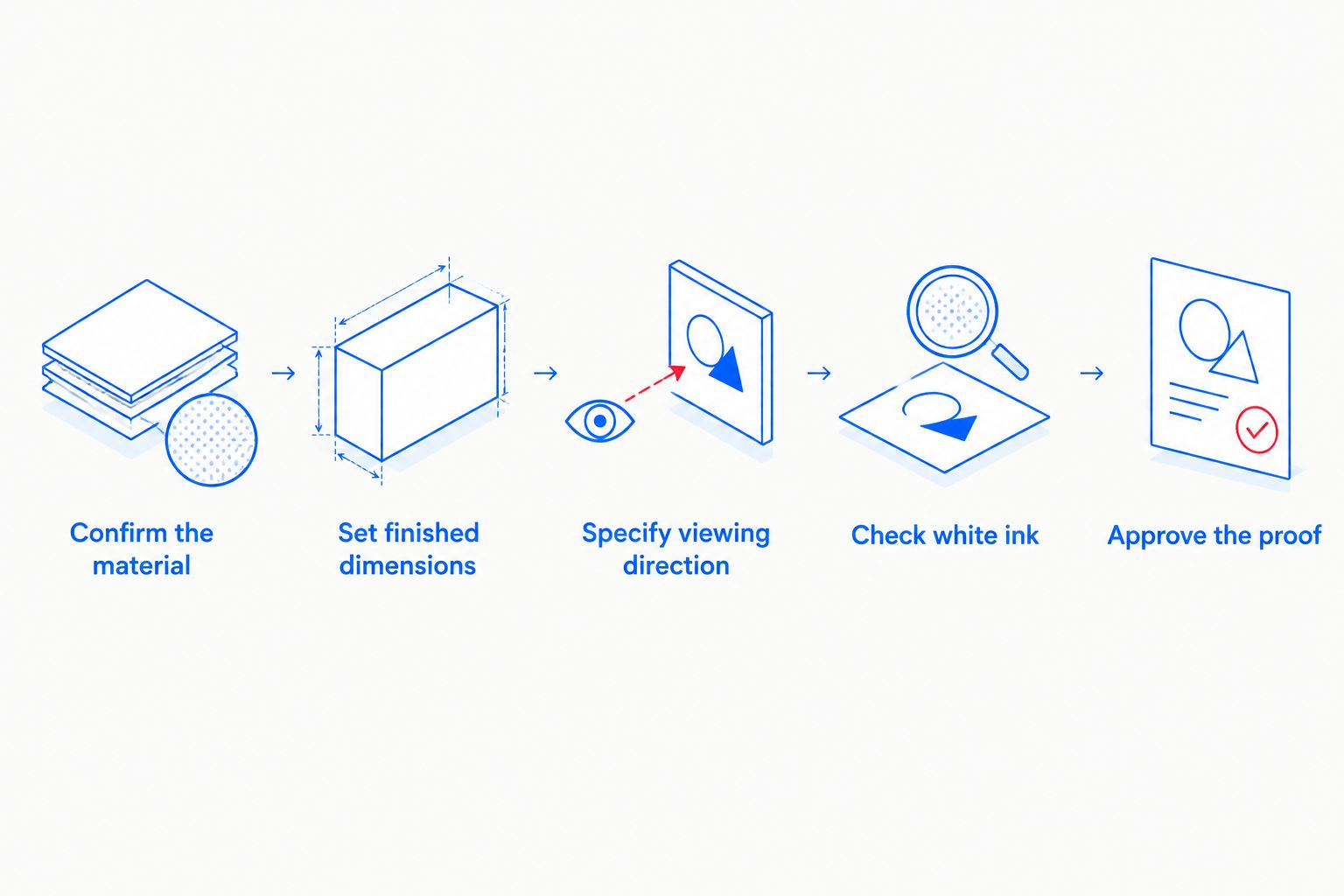
Confirm the material
Record the exact material name and attachment requirement. Keep clear adhesive vinyl, white static cling, and matte adhesive vinyl as separate specifications even when they share the same design.
Set finished dimensions
Supply the finished width and height, not just a file that looks correct on screen. Identify whether those dimensions describe the entire decal boundary or only the printed artwork. Measure the intended pane and check clearance around handles, frames, and existing signage.
Specify viewing direction
State where the decal will be installed and where the reader will stand. An inside-mounted graphic read from the street needs a different production discussion from an outside-mounted graphic read from the same side. Do not mirror artwork without confirming the requested setup.
Check white ink
Ask whether the design needs white ink behind selected areas and whether that setup is supported. Identify which areas must stay transparent. A white background in a mockup is not enough to communicate either instruction.
Approve the proof
Check spelling, dimensions, orientation, transparent areas, and the intended cut boundary. Save the approved proof with the production file. For repeat work, approve changes explicitly instead of assuming an older order supplies every instruction.
Resolve material and viewing direction before approving the storefront file.
A production-ready order pairs the file with those decisions. If the artwork changes but the material stays the same, preserve the original material record and replace only the approved design version.
Choose the material that matches the brief
Brooklyntransfers offers the three materials below. Use the transparent option for a clear-carrier requirement; select the alternatives only when their attachment method or finish answers a different need.
4 mil calendered vinyl with a matte finish and permanent adhesive.
$1.50
How we ranked these storefront materials
The ranking follows the buying brief: transparent carrier first, attachment method second, then finish and production requirements. Clear Cal Vinyl ranks first because its stated construction directly answers the clear-film query.
White Static Cling and Matte Cal Vinyl fill different use cases rather than competing for the same slot. This 2026 guide uses the listed material specifications; it does not assign unsupported durability scores, removal ratings, or outdoor-life estimates.
Which storefront decal material should you choose?
Choose Clear Cal Vinyl by default when the job genuinely requires a transparent carrier with permanent adhesive. Choose White Static Cling when the brief instead requires white film without adhesive. Choose Matte Cal Vinyl only when the required finish is matte and transparency is unnecessary.
For a repeat storefront program, standardize the material name, approved dimensions, and viewing direction before placing the next order. That gives your production team a usable specification rather than a visual reference they have to interpret.
FAQ
What's the best clear vinyl decal material for glass storefronts?
Clear Cal Vinyl is the best match among these options for a transparent storefront graphic with permanent adhesive. Its listed construction is 3 mil clear calendered vinyl, and it is described as water-resistant. Confirm compatibility with the actual glass before ordering.
Is clear vinyl better than static cling for window graphics?
Clear vinyl is better when transparency and permanent adhesive are required; White Static Cling is better when the brief requires white film without adhesive. These materials solve different jobs, so choose by background and attachment method rather than thickness.
Will clear vinyl make every part of my design transparent?
Clear vinyl supplies a transparent carrier, not transparent printed artwork. Ink coverage and any white backing determine which printed areas block the view. Specify the areas that must remain clear in the production brief.
Can I install a decal inside the window so people read it outside?
Specify inside installation and outside-facing reading before production. Confirm artwork orientation, ink arrangement, and adhesive placement with the printer. Do not assume a standard decal order covers that setup.
Does water-resistant clear vinyl have a guaranteed outdoor lifespan?
A water-resistant description does not establish a guaranteed outdoor lifespan. Confirm the intended exposure and application with the supplier, and do not assign a service-life figure from film thickness alone.
What should I send with a storefront decal file?
Send the exact material name, finished dimensions, installation side, reading direction, and intended transparent areas. Ask about white ink and the required cut boundary before approving the proof. Keep the approved version for repeat orders.
Does the DTF same-day cutoff apply to vinyl decal orders?
Do not apply the DTF same-day cutoff to vinyl decal orders. Brooklyntransfers states that DTF orders placed by 1:00 PM Eastern ship or are ready for pickup the same day; confirm vinyl timing separately. Same-day dispatch does not mean same-day delivery.
One last thing
Proof your 2026 storefront graphic against the view through the actual window, not only against a white artboard. Photograph the intended pane from the customer's viewing position and use that image as the proof background. This checks the design against the scene it must compete with; it does not replace a material or print proof.
A transparent carrier is a material choice. Readable storefront artwork is a separate approval. Keep both decisions in the order record.