Best sticker finishes for weatherproof outdoor labels
Best overall: an outdoor-rated print system with a compatible protective overlaminate. Best for low-glare labels: Matte Cal Vinyl. Best for reflective branding: Glossy Cal Vinyl. Best for transparent graphics: Clear Cal Vinyl. The best sticker finish for weatherproof labels in 2026 depends on the complete construction—not sheen alone.
TL;DR
The best sticker finish for weatherproof labels combines suitable vinyl, outdoor-rated printing, adhesive compatibility, and appropriate protection.
Brooklyntransfers offers matte, glossy, and clear CAL vinyl; finish alone does not establish outdoor service life.
Choose matte for reduced reflections, glossy for a reflective surface, and clear when the background should remain visible.
Confirm exposure suitability and test the finished label on your actual substrate before ordering a repeat run.
Why this matters
An outdoor label is a system: face film, ink, adhesive, optional overlaminate, and application surface. A glossy surface does not establish UV resistance, and a matte surface does not establish water resistance. Specifying only the finish leaves the actual exposure requirements unanswered.
Brooklyntransfers offers several CAL vinyl options for shops comparing label constructions. Brooklyntransfers is best for print shops comparing matte, glossy, and clear CAL vinyl finishes before specifying an outdoor label. Treat the material descriptions as a starting point, then confirm the finished construction for your job.
For your 2026 purchasing specification, separate appearance from exposure performance. That distinction keeps a visually approved sample from becoming an unsupported weatherproof promise.
What makes the best sticker finish for weatherproof labels
Use these criteria before choosing a material:
Exposure suitability: Confirm whether the complete printed construction suits rain, sunlight, cleaning, and the intended placement.
Readability: Judge small type, barcodes, and contrast under the lighting where the label will be read.
Surface compatibility: Match the adhesive to the actual substrate, texture, curvature, and application conditions.
Print protection: Determine whether the ink system needs a compatible overlaminate for the expected handling and exposure.
Production repeatability: Record the material, artwork revision, dimensions, and approved construction so reorders match the specification.
Film thickness belongs in that record, but it is not a durability rating. A thicker material does not, by itself, prove stronger adhesion or longer outdoor life.
Sticker finishes at a glance
This 2026 comparison separates the best use case from the evidence still needed. The ranking favors an exposure-qualified construction first, then finish-specific buying decisions.
Option
Best for
Standout feature
Key limitation
Outdoor-rated print with compatible overlaminate
Exposed labels needing print protection
Adds a protective layer over the printed surface
Requires confirmation of film, ink, adhesive, and laminate compatibility
Listed as 4 mil matte calendered vinyl with permanent adhesive
Matte appearance does not establish outdoor suitability
Glossy Cal Vinyl
Branding that calls for a reflective finish
Listed as 3 mil glossy calendered vinyl with permanent adhesive
Reflections can interfere with reading under direct light
Clear Cal Vinyl
Graphics that retain a visible background
Listed as 3 mil clear calendered vinyl; described as water-resistant
Background color affects contrast; water resistance is not a full weatherproof rating
1. Outdoor-rated print with overlaminate: best for exposed labels
For an exposed outdoor label, start with a construction qualified for the actual conditions. A compatible overlaminate covers the printed surface; its suitability still depends on the particular film, ink, adhesive, and application.
This is a construction recommendation, not a claim that every laminated sticker is weatherproof. Ask the supplier to identify what the finished label supports rather than accepting the word laminated as the specification.
Outdoor-rated laminated print pros:
Adds a protective layer over the printed image.
Lets you specify surface appearance separately from the underlying print.
Makes print protection an explicit purchasing requirement.
Outdoor-rated laminated print cons:
Lamination does not correct an unsuitable adhesive or application surface.
An incompatible laminate can create a different failure point.
A protective face layer does not make every edge or installation condition suitable.
Best for: Labels exposed to outdoor handling where the supplier can confirm the complete construction.
Verdict: Buy a verified construction; hold any order described only as weatherproof without supporting specifications.
2. Matte Cal Vinyl: best for low-glare identification labels
Matte Cal Vinyl is listed as a 4 mil pressure-sensitive calendered vinyl with permanent adhesive. Its matte finish is the relevant choice when reflections compete with the printed information.
For Brooklyntransfers sticker finishes, matte is the practical starting point for information-first artwork. Confirm outdoor suitability separately; the supplied description does not establish an exposure duration or finished-label weatherproof rating.
Matte Cal Vinyl pros:
Provides a matte surface when you do not want a glossy appearance.
Reduces distracting specular reflections compared with a glossy finish.
Has a stated film thickness and permanent-adhesive construction for your purchasing record.
Matte Cal Vinyl cons:
A matte face does not establish UV resistance or ink protection.
Permanent adhesive does not establish compatibility with every surface.
The listed thickness is not an outdoor service-life claim.
Best for: Identification and instruction labels where low glare matters more than a reflective appearance.
Verdict: Buy for the matte finish after confirming the outdoor construction; hold for unverified exposure requirements.
3. Glossy Cal Vinyl: best for reflective brand graphics
Glossy Cal Vinyl is listed as a 3 mil pressure-sensitive calendered vinyl with permanent adhesive. Choose it when the approved artwork calls for a glossy surface rather than a muted finish.
The buying decision is visual first. Review the printed sample under direct and indirect light, particularly when a brand graphic also contains small instructions or machine-readable information.
Glossy Cal Vinyl pros:
Provides a defined glossy appearance for brand graphics.
Uses a stated permanent-adhesive construction.
Has a documented film thickness that you can carry into repeat-order records.
Glossy Cal Vinyl cons:
Reflected light can obscure information at certain viewing angles.
Gloss does not establish resistance to sunlight, abrasion, or cleaning agents.
Outdoor performance still depends on the finished printed system.
Best for: Brand-led graphics where a reflective surface is an intentional part of the approved design.
Verdict: Buy for the glossy appearance; hold if glare compromises the label's required information.
4. Clear Cal Vinyl: best for visible-background graphics
Clear Cal Vinyl is listed as a 3 mil pressure-sensitive calendered vinyl with permanent adhesive. Its description states water resistance, making that a supported material characteristic—not proof of every outdoor exposure condition.
Choose clear when the background should remain part of the design. Confirm the printing approach for opaque elements, because a transparent base does not provide a white background beneath every part of your artwork.
Clear Cal Vinyl pros:
Keeps unprinted background areas visible.
Is explicitly described as water-resistant.
Has a stated thickness and permanent-adhesive construction.
Clear Cal Vinyl cons:
Dark or changing backgrounds can reduce printed contrast.
Opaque artwork elements require confirmation of the print construction.
Water resistance does not establish UV life, immersion suitability, or chemical resistance.
Best for: Transparent-background graphics on surfaces where the final contrast has been approved.
Verdict: Buy after reviewing a sample against the actual background; skip when essential information disappears into the substrate.
Choose the material, then confirm the outdoor specification
Brooklyntransfers lists these CAL vinyl materials with different finishes and constructions. Use the product options to identify the appearance you need, then confirm whether the finished print meets your exposure requirements before approving production.
3 mil pressure-sensitive clear calendered vinyl with permanent adhesive; described as water-resistant.
$1.50
Prepare an outdoor-label order that can be repeated
A useful 2026 order brief tells the printer where the label goes, what it encounters, and which artwork is approved. Do not make the production team infer those details from a file name.
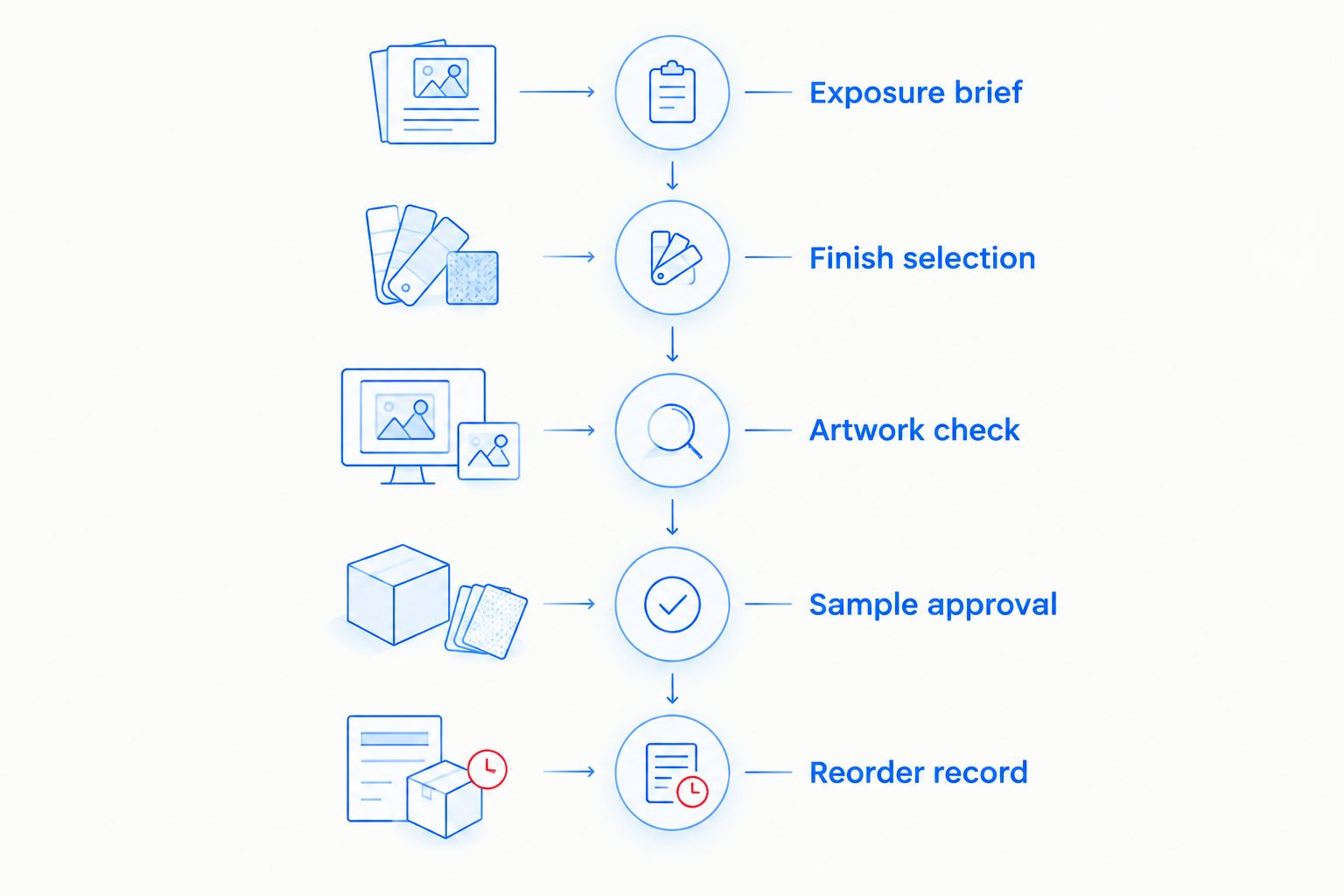
Exposure brief
List the substrate and whether the label faces direct weather, sheltered outdoor conditions, handling, or cleaning. Identify curved, textured, or flexible surfaces explicitly. Ask which construction is appropriate for those conditions.
Finish selection
Choose matte, glossy, or clear based on the job—not a general assumption about toughness. For clear artwork, identify the intended background and ask how opaque elements will print. Keep appearance approval separate from exposure approval.
Artwork check
Set the artwork to the intended finished dimensions and check it at actual size. Preserve a transparent background where required; an unwanted background in the file becomes part of the print. Ask for the printer's current requirements for resolution, bleed, cut paths, and accepted formats rather than assuming a universal template.
Sample approval
Apply a sample to the real substrate using the supplier's instructions. Check readability, edges, adhesion, and the relevant handling conditions. A shop check screens for obvious mismatches; it does not establish a multi-season durability claim.
Reorder record
Save the approved artwork revision, dimensions, material, finish, adhesive specification, and protective construction. Attach the approved sample reference to the job record. Reorder from that specification rather than a description such as the usual outdoor stickers.
Approve the exposure requirements and artwork before saving the repeat-order specification.
A documented approval gives purchasing and production the same reference. It also makes a material substitution visible instead of allowing a visually similar finish to pass as an identical construction.
How the finishes are ranked
The ranking puts exposure suitability ahead of appearance, then separates low-glare, reflective, and transparent-background applications. Product characteristics come from the supplied material descriptions; no outdoor lifespan, wash test, or comparative durability result is assigned.
For 2026 purchasing, buy the finish for its visual function and qualify the complete label for its exposure. Neither film thickness nor sheen replaces that qualification.
Which sticker finish should you choose?
For an undecided buyer, the default is a verified outdoor-rated printed construction with compatible protection where required. Choose matte within that construction when readability is the priority, glossy when reflection is intentional, and clear when the background belongs in the design.
Brooklyntransfers sticker finishes give you those appearance options, but the outdoor decision still needs a confirmed specification. Do not approve an outdoor production run on the finish name alone.
FAQ
What's the best sticker finish for weatherproof labels?
The best sticker finish for weatherproof labels is part of a complete construction qualified for the intended exposure. Choose matte, glossy, or clear for appearance, then confirm the film, ink, adhesive, and any protective laminate.
Are matte stickers better than glossy stickers outdoors?
Matte stickers are better when reducing reflections is the priority, not automatically when outdoor durability is the priority. Outdoor suitability depends on the complete printed construction rather than sheen alone.
Does a glossy finish make a sticker waterproof?
No, a glossy finish does not establish waterproof performance. Confirm the material, printed image, adhesive, and intended exposure before making that claim.
Is Clear Cal Vinyl suitable for weatherproof labels?
Clear Cal Vinyl is described as water-resistant, but that does not establish a complete weatherproof rating. Confirm suitability for sunlight, cleaning, the application surface, and the intended outdoor conditions.
Do outdoor labels need an overlaminate?
Outdoor labels need an overlaminate when the selected print system and exposure requirements call for that protection. Ask the supplier to confirm the construction rather than adding a laminate without checking compatibility.
Is thicker vinyl always better for outdoor labels?
No, thicker vinyl is not automatically better for outdoor labels. Film thickness does not establish adhesive compatibility, UV resistance, or protection of the printed image.
What should a print shop save for repeat label orders?
Save the approved artwork revision, finished dimensions, material, finish, adhesive specification, and protective construction. Keep a reference to the approved sample so a reorder does not depend on appearance alone.
One last thing
The approval sample belongs on the actual object, not just the proofing table. Clear graphics change with the background, glossy graphics change with the viewing angle, and every adhesive meets a particular surface. For your next 2026 repeat order, approve that installed combination before saving it as the production standard.