Best custom sticker materials for product packaging
Best overall: Glossy Cal Vinyl. Best for a low-glare finish: Matte Cal Vinyl. Best for showing the package beneath the label: Clear Cal Vinyl. This 2026 guide compares the best sticker materials for product packaging, with practical ordering checks for apparel brands, print shops, and creators buying custom stickers from Brooklyntransfers.
TL;DR
Glossy Cal Vinyl is the default among the best sticker materials for product packaging when you want a glossy finish.
Choose Matte Cal Vinyl for low-glare packaging labels; choose Clear Cal Vinyl when the package should show through.
Brooklyntransfers offers custom stickers; confirm material suitability against your actual packaging before placing repeat orders.
DTF gang sheets decorate apparel. Adhesive vinyl stickers serve a different job on product packaging.
Why this matters
A packaging sticker has to suit the surface it lands on, not just the artwork you upload. A good-looking proof does not establish adhesion on a textured carton, a flexible pouch, or a coated mailer.
For repeat orders in 2026, settle the material and application method before standardizing the design. Approve the label on the actual package, then keep that combination consistent. A material change belongs in your production checks, just like an artwork revision.
The selection below separates finish, transparency, adhesive type, and application suitability. Those are different decisions. Gloss describes appearance; permanent adhesive describes the intended bond, not proof that the label will adhere equally to every packaging surface.
What makes the best sticker materials for product packaging?
Use these criteria before choosing a material:
Package surface: Check the actual carton, pouch, jar, sleeve, or mailer. Texture, coatings, curves, and flex affect how a label behaves.
Finish: Choose glossy for reflected shine or matte when reducing glare matters more. Review the finish under the lighting used for packing and photography.
Transparency: Decide whether the label should cover the package or let its color and contents remain visible.
Adhesive fit: Permanent adhesive and removable adhesive serve different jobs. Neither designation replaces a package-specific application check.
Handling conditions: Identify exposure to moisture, rubbing, bending, and storage conditions. Do not treat a material name as a durability certification.
Repeat-order control: Record the material, finished dimensions, approved file, and packaging substrate so the next order matches the approved job.
Choose the packaging surface first, the finish second, and the artwork treatment third. That order prevents a finish preference from deciding an application it cannot support.
Best packaging sticker materials at a glance
These recommendations cover external packaging labels. They do not establish suitability for direct food contact, regulated labeling, or tamper-evident applications.
Material
Best for
Standout feature
Key limitation
Glossy Cal Vinyl
General packaging labels with a glossy finish
3 mil calendered vinyl with permanent adhesive
Reflections need checking around small text and photography
Not the choice when the approved design requires gloss
Clear Cal Vinyl
Labels that leave the package visible
3 mil clear calendered vinyl with permanent adhesive
Artwork contrast depends on the surface behind it
Thickness is a material specification, not a performance ranking. The 4 mil matte film is thicker than the listed 3 mil glossy and clear films; that difference alone does not establish better adhesion or longer service life.
1. Glossy Cal Vinyl: best packaging sticker material for glossy branding
Glossy Cal Vinyl is a pressure-sensitive calendered vinyl with permanent adhesive and a glossy finish. Choose it when your packaging design calls for shine rather than a subdued surface.
For a repeat-order workflow, start with the package you already use. Apply the proposed label to that package and review the complete presentation: label edges, artwork visibility, handling, and reflected light. A flat artwork preview cannot show all of those conditions.
Glossy Cal Vinyl pros:
Provides the glossy finish specified for the material.
Uses permanent adhesive rather than a removable adhesive system.
Gives you a defined 3 mil film specification to record on the job sheet.
Glossy Cal Vinyl cons:
Gloss introduces reflections that need checking around small copy.
Permanent adhesive is not a substitute for testing the actual packaging substrate.
A glossy finish does not establish scratch resistance, outdoor life, or suitability for washing.
Best for: Brands whose approved packaging presentation calls for a glossy label, with the application confirmed on the intended surface.
Ask the packer to review the label while handling the finished package, not only while it sits flat on a desk. If a highlight crosses a care instruction or product identifier, adjust the layout or reconsider the finish before repeating the order.
Verdict: Buy Glossy Cal Vinyl when gloss is intentional and the package test passes.
2. Matte Cal Vinyl: best packaging sticker material for low-glare labels
Matte Cal Vinyl is a 4 mil pressure-sensitive calendered vinyl with permanent adhesive. Its matte finish makes it the practical choice when reflected shine conflicts with your label design.
Use matte as a finish decision, not as shorthand for a stronger or more sustainable material. Neither claim follows from the supplied specification. For Brooklyntransfers packaging stickers, Matte Cal Vinyl is the best fit when a low-glare finish is the priority.
Matte Cal Vinyl pros:
Offers a matte finish for designs that avoid glossy reflections.
Uses permanent adhesive for applications intended to stay attached.
Has a stated 4 mil thickness, making the material specification clear for reorders.
Matte Cal Vinyl cons:
Does not reproduce the shine of an approved glossy label.
Its thickness does not establish suitability for tight curves or flexible packages.
A matte appearance does not prove scuff resistance or water resistance.
Best for: Packaging labels where restrained shine and readable presentation matter more than a glossy effect.
Check the smallest text at the finished print size. Matte material cannot rescue tiny copy, weak contrast, or a file enlarged beyond its usable resolution. Keep those checks separate so you solve the actual problem rather than changing materials unnecessarily.
Verdict: Buy Matte Cal Vinyl for a low-glare finish after checking the real package.
3. Clear Cal Vinyl: best packaging sticker material for visible backgrounds
Clear Cal Vinyl is a 3 mil pressure-sensitive calendered vinyl with permanent adhesive. The product description identifies it as water-resistant; that is not a claim of waterproofing or suitability for immersion.
Choose clear when the package beneath the label should remain part of the design. Transparency makes the background an active design variable: the same artwork needs separate review on a dark container, a light container, and a transparent package with visible contents.
Clear Cal Vinyl pros:
Keeps the underlying package visible through unprinted areas.
Uses permanent adhesive rather than a self-clinging film.
Has an explicitly stated water-resistant material description.
Clear Cal Vinyl cons:
Text and artwork contrast depend on the background beneath the label.
Transparent film does not establish how white artwork or white ink will be produced.
Water resistance does not establish dishwasher suitability or repeated-washing performance.
Best for: Labels designed around the appearance of the container or package beneath them.
Before ordering, confirm how the artwork will print, especially where white elements or opaque coverage are necessary. Do not assume that a white area in your file will become printed white rather than an unprinted area. Resolve that question before approving the design.
Verdict: Buy Clear Cal Vinyl only after background contrast and ink treatment are confirmed.
Choose the material that matches the approved finish
The Brooklyntransfers custom sticker materials below correspond to the three recommendations. Keep the selected material name with your approved artwork so a reorder does not silently become a finish change.
3 mil pressure-sensitive calendered vinyl with permanent adhesive; described as water-resistant.
$1.50
Materials to hold or skip for packaging labels
Not every printable material is an adhesive packaging sticker. These alternatives have distinct uses, but the supplied descriptions do not make them default choices for product labels.
Material
Best for
Useful property
Packaging limitation
Verdict
Solvent Glossy Paper
Printed paper applications
Coated heavyweight paper for full-color printing
The supplied description does not specify an adhesive backing
Intended use differs from permanent packaging labeling
Hold unless removability is required and the package is tested
The distinction matters when you order by material name alone. A printable glossy paper is not automatically sticker paper, and a film that clings to glass is not automatically suitable for a shipping carton.
Prepare a repeatable packaging sticker order
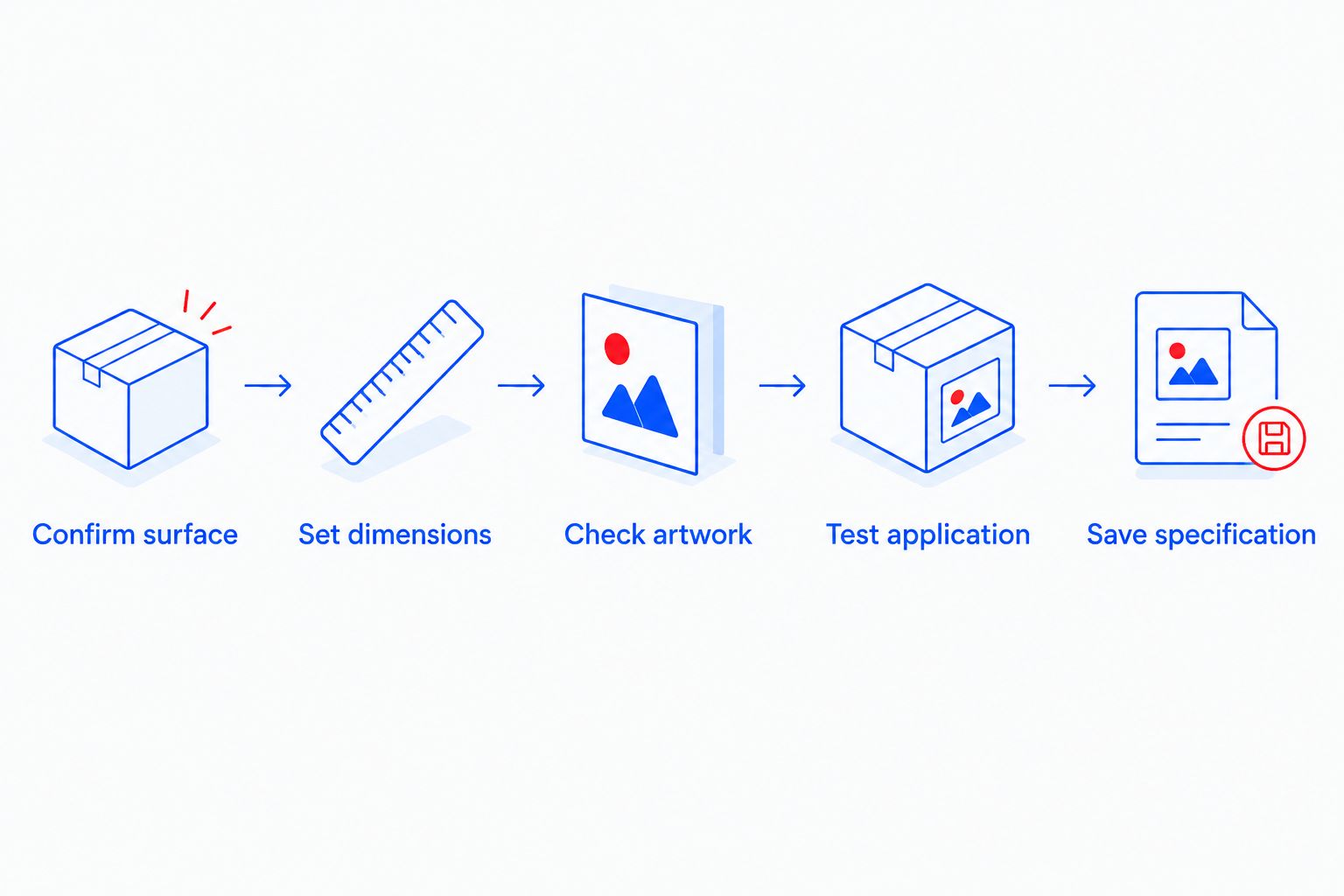
Use this sequence for your 2026 purchasing checklist. It connects the package, file, and finished application instead of treating the artwork upload as the whole job.
Confirm surface: Record the packaging material and finish. Keep an actual package available for the application check.
Set dimensions: Measure the usable label area, including clearance from folds, seams, openings, and strongly curved sections.
Check artwork: Inspect at final size. Confirm readable copy, background contrast, transparency, and the intended treatment of white elements.
Test application: Apply a sample to the actual package. Check edge contact, handling, bending, and the conditions relevant to the job.
Save specification: Store the approved file with the material name, finished dimensions, package reference, and application notes.
Approve the package and label together before repeating the order.
Ask for the current artwork requirements rather than assuming a universal bleed, resolution, or cut-line setup. Those requirements belong to the print workflow, and the supplied product descriptions do not define them.
Keep production timing separate from delivery timing, too. The stated DTF cutoff does not establish sticker production timing. Confirm the schedule for your sticker order before committing to a packaging deadline.
How these materials are ranked
The 2026 ranking uses the supplied material descriptions: finish, transparency, thickness, adhesive type, and stated application. Glossy Cal Vinyl is the default glossy option; matte and clear take distinct use-case slots rather than competing on an unsupported durability score.
No hands-on comparison or wear test is claimed. Package-specific approval remains the deciding step for every material on the list.
Which packaging sticker material should you choose?
Choose Glossy Cal Vinyl if you want a glossy packaging label and have no transparency or low-glare requirement. Choose Matte Cal Vinyl when reflected shine is the problem. Choose Clear Cal Vinyl when showing the package beneath the label is part of the design.
For a Brooklyntransfers reorder, retain the exact approved material instead of requesting only “the same stickers.” The useful instruction is the material, dimensions, artwork revision, and package reference together.
FAQ
What's the best sticker material for product packaging in 2026?
Glossy Cal Vinyl is the default choice for packaging labels that need a glossy finish. Choose Matte Cal Vinyl for low glare or Clear Cal Vinyl when the package should show through; confirm each material on the actual surface.
Is matte vinyl better than glossy vinyl for packaging?
Matte vinyl is better when reducing reflected shine is the priority. Glossy vinyl fits a glossy presentation; the finish alone does not establish better adhesion or durability.
Are clear vinyl packaging stickers waterproof?
Clear Cal Vinyl is described as water-resistant, not waterproof. Do not treat that description as approval for immersion, dishwashing, or repeated washing.
Can I use vinyl stickers on cardboard boxes?
Approve vinyl stickers on the exact cardboard box before placing a repeat order. Texture, coatings, folds, and the application area need checking rather than assuming all cardboard behaves alike.
Will white artwork print white on clear stickers?
Confirm the white-ink treatment before approving clear stickers. A white area in an artwork preview does not by itself establish whether that area will print white or remain transparent.
Is static cling suitable for packaging labels?
White Static Cling is not the default for adhesive packaging labels because it uses no adhesive. Its stated application includes glass, so keep that use separate from labeling cartons and mailers.
Can I use a DTF gang sheet for packaging stickers?
A DTF gang sheet is not the same product as an adhesive packaging sticker. Order the material for its intended application rather than treating apparel transfers and packaging labels as interchangeable.
Does the same-day DTF cutoff apply to sticker orders?
Do not apply the DTF cutoff to sticker orders. The stated policy covers DTF orders placed by 1:00 PM Eastern shipping or being ready for pickup the same day; it does not promise same-day delivery or establish sticker timing.
One last thing
Keep an approved package, not just an approved artwork file. A physical reference preserves the finish, placement, background, and edge behavior that a screen preview leaves out.
Make that reference part of your 2026 reorder process. If the package supplier, coating, shape, or material changes, check the sticker again before treating the job as a straight repeat.